
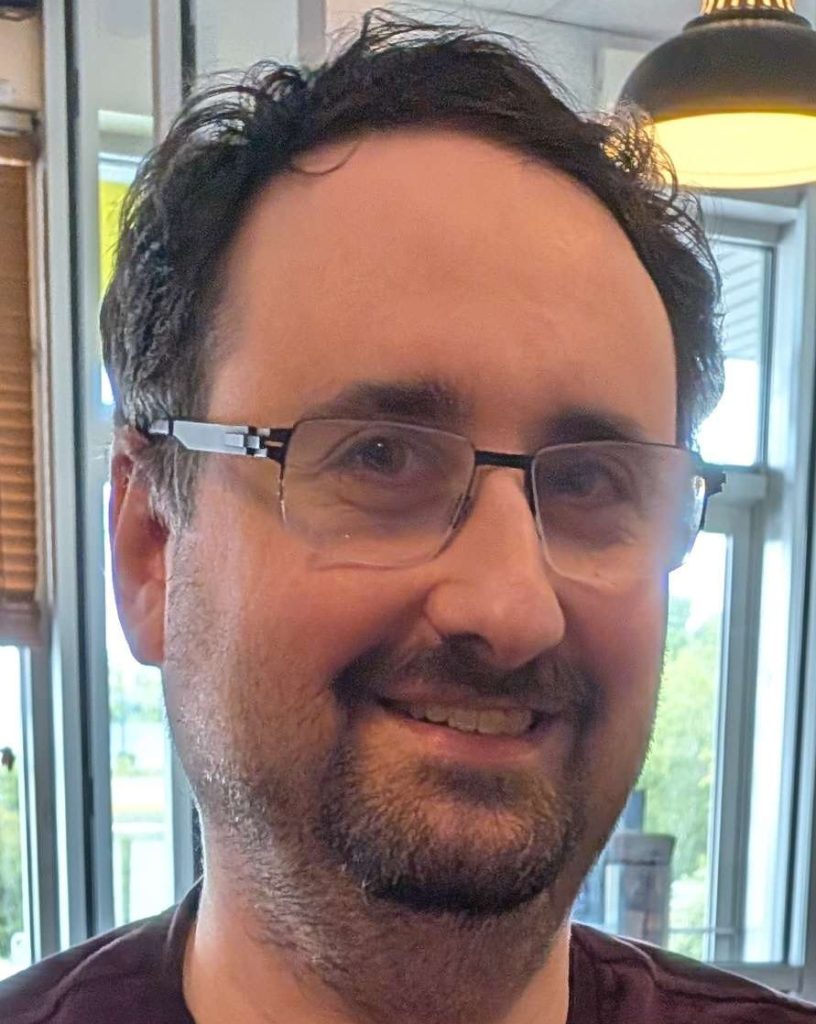
Dave is an Autistic/ADHD CFP® Professional who works with Autistic individuals and families with Autistic children, helping them navigate their finances and plan for the future. He lives with his wife Mary in the Lakes Region New Hampshire. When Dave is not at work, he enjoys going out to eat with his wife, hanging out with his two cats, and playing games that revolve around space and flight simulation, economy simulation, and open-world roleplaying. Dave also enjoys creative writing and previously published the thriller Persona Jeremy and is working on a fantasy novel in his spare time. Dave’s full bio can be found at https://edwardjones.com/dave-bochichio. This week Dave shared some of his experiences as a late-diagnosed Autistic adult and his journey to serve the Neurodivergent community as a professional financial planner.
When/how did you discover you are Neurodivergent? Was this discovery explained by others/perceived by you as something positive, negative or neutral? Explain.
I always knew I was different than the other kids when I was in elementary school. I was fascinated by things that did not interest others. I was fairly obsessed with astronomy and could recite facts about the solar system and such like “everyone should know this.” I also started writing fantasy-genre stories from the time I was in 3rd grade (and I still do on occasion), granted they were simple at the time. I had no idea that I was autistic until an adolescent psychiatrist suggested to my mother that I get evaluated. I was evaluated and diagnosed when I was 15, but I honestly didn’t come to terms with the diagnosis until my late 30s.
What drew you to the finance profession? What do you enjoy most about it?
I play a lot of roleplaying video games, including online games. Making virtual currency is vital for getting ahead in most of these games. I got really good at making money in video games and carefully portioning out the money to buy things for my characters. I realized if I could do that in a game, why couldn’t I do that in real life? I learned everything I could about budgeting, saving, getting out of debt, side hustles, passive income, and investing. I ran a personal finance blog for three years and wrote a book, but I felt like I still wasn’t meaningfully contributing. It was at that time, an acquaintance of mine who is a CFP Professional and has an autistic daughter suggested that I might be perfect as a financial advisor serving autistic clients as an autistic person myself. She told me it is an underserved niche and that I could help so many people that way. I discovered that there were a few local financial firms where I lived, and I ended up applying to Edward Jones, where I was hired.
Describe your journey to understanding money management. What influences shaped your understanding of money and saving? For example, did anyone in your family teach you how to save and spend appropriately? Was this something you learned on your own or much later on in life from outside sources?
My parents are frugal, though I was not frugal myself growing up. My wife and I were not good with our finances in our 20s. It was when I ended up on SSDI and we had to cut back on everything that we learned to budget and live as beneath our means as possible since we had such a limited income. My wife is also autistic, but she was undiagnosed at that time and was struggling with employment herself. Let’s just say we quickly learned to be good with our finances out of absolute necessity. Part of why I became a financial advisor was to help folks get out of or avoid situations like we were in by 1) managing clients’ money and 2) providing education around how to plan for the future and why it’s so important. I also talk a bit about money habits and money anxiety for clients who need help in those areas.
How are you uniquely positioned to serve the financial planning needs of the Neurodivergent community? What are your strengths as a financial counselor?
Being autistic myself, I have some of the same or similar lived experiences as my autistic clients. I also grew up in a family that did not spend a lot of money because they were concerned that when I became an adult, they would have to place me in a group home or clinical setting or have a permanent aid for me that they would have had to pay for. This perspective helps me support both autistic clients and families with autistic children who are planning for the unknown. Additionally, before I came to Edward Jones, I served as a suicide intervention crisis counselor for two years and talked a lot of people “off the ledge.” I use this experience when talking to clients who experience anxiety and uncertainty.
Are there unique challenges you see Neurodivergent adults experience with money management or long-term financial planning?
There are a few that have come up somewhat frequently.
1) Shiny object syndrome. I did not coin the term, but shiny object syndrome is when you do something such as go on Amazon, see something you want, click Buy, and when it arrives the next day, you’ve already moved on and want to buy something else, never really using the “shiny object” that you just bought.
2) Talking head overwhelm – perhaps more my own term. This is when everyone on the internet has their own opinion about investing and my client has no idea who to listen to. I help them filter out the noise and provide logical and emotional connections to their money and their goals.
3) Sacrifice a little bit today to have a much better tomorrow, versus the opposite. Again, not my original philosophy. While I will never tell someone not to enjoy their life in the present, putting some of your money away today is how you live more comfortably tomorrow. Finding that happy balance between getting through each week and “one day I will retire and not worry about running out of money before I die.”
While learning to live authentically is likely a never-ending journey for both Autistic and Allistic people, where have you made progress in this area? How have you learned to adopt an autism-positive identity and live authentically?
I did not even talk about being autistic until my late 30s. I was almost entirely acting/masking daily, and it was exhausting. Today I feel like I am pretty intentional about how I am. I don’t hide that I am autistic – I probably say it more than I need to lol. But I think talking about being autistic and being real with people about the struggles I have gone through and still do to this day gives hope and inspiration for other autistic folks and parents of autistic kids.
Anything else you’d like to talk about or share that I didn’t ask about?
Navigating adulthood as an autistic individual, similar to perhaps anyone, is a journey. In my 20s I would have laughed at someone asking me if I’d ever be a financial advisor, being on the phone everyday and talking to people/strangers all the time. That type of stuff terrified me. If you told me I would be happily married, own a house, and maintain a small but active social circle, I would have told you you were out of your mind. My words to someone who is struggling terribly is that the journey can be slow and challenging, but making the decision to show up every day and take small steps forward will pay off in the long term.