
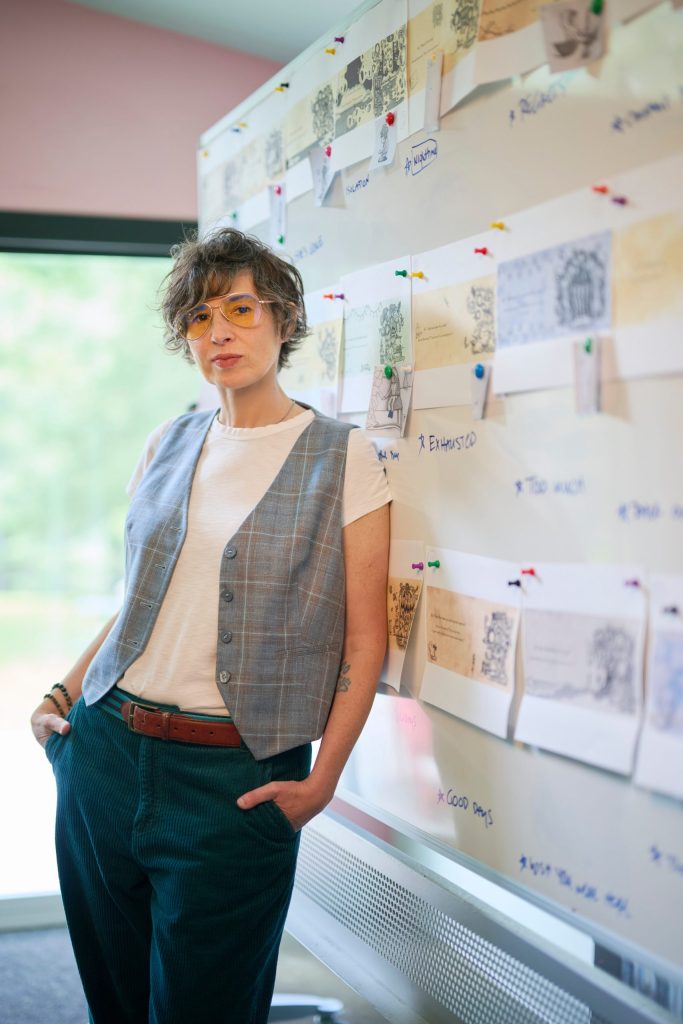
JFo is a naturally gifted illustrator & painter. Never having a single lesson in the creation of art, she has been drawing since she could hold a pencil. People who’ve known her would call it an obsession. She would call it natural & necessary. Her imagination and drive to express what she envisions are truly inexhaustible. JFo discovered late in life that she is on the Autism Spectrum, and is still uncovering all the ways that this has touched and influences her day-to-day life. This week she shared her journey of self-discovery as well as details of her upcoming illustrated diary Grief Monster.
Photo credit – Josiah Lewis Images
When/how did you discover you are Neurodivergent? Was this discovery explained/perceived by you as something positive, negative or neutral? Explain.
I discovered I was Neurodivergent at age 52 upon speaking to a brand new therapist (who happened to be Neurodivergent herself). Truthfully, I didn’t really know what “neurodivergent” meant, I didn’t know she was on the Spectrum, and I wasn’t looking for any of it. I was talking to her about my life, and at the tail-end of the session, she recommended that I buy a book on Amazon: I Think I Might Be Autistic. Just like that. She ended the call, and I fell to the floor crying. I’m not totally sure why I had such an emotional reaction to her suggestion—maybe because I knew deep down that this was both the answer I was seeking and was also so afraid of for so long. That, and I really didn’t understand anything about it—it just felt very scary and overwhelming. This was last November, so nearly a year ago. Since then, I read that book (and several others), I took the tests, and I’ve been on a deep dive getting answers to questions I’ve had my entire life. Finding out I am Autistic was enormously positive for countless reasons—and also the most mind-bending and challenging time in my entire life. It was like going back to square one and learning how to live—without masking, hiding, or white-knuckling everything this time—all over again. The revelation essentially blew up my world and sent me into Autistic burnout, which I’m still in, but starting to come out of slowly. It’s been a rollercoaster, but I am very grateful to have this part of myself in the light.
On your website, you mention that you have been drawing since childhood, but you’ve never had any formal art lessons. Do you seek ways to hone your craft informally on your own? How have you evolved as an artist since childhood?
I can’t really say I seek ways to hone my artwork. I’m sure if I spent the time and energy I could improve my technical skill—I challenge myself with photorealistic paintings from time to time, and always feel satisfied with the outcome. But honestly, I’d just rather spend my time making art than learning about making art. It’s too much fun to get bogged down with technicalities—it’s just not what I’m interested in. My most major evolution across my life is going from making art for other people to making art for myself…expressing my emotions and experiences and perspectives through my art, rather than making things just to please others.
After the death of your mother, did the idea of Grief Monster as an illustrated journal come naturally to you? When did you start it?
After my mother’s death, a friend suggested the book Bearing the Unbearable by Dr. Joanne Cacciatore. In this book she asks you about your grief monster. She says to imagine what they look like, and how they change, and suggests that the monster just wants to have tea with you. Before I knew it, I was sketching my monster, and my little JFo character, and the little tea cup…never knowing that I was making a book to share with others. I started the diary a few months after my mother’s death. It was such a cathartic tool that I kept making entries. Two years later, I realized that I channeled all the energy of my Early Stage Grief into my drawings, 23 in total. My wife, JC Wilde, saw something much bigger than diary entries—and we started J & J Publishing House with the intention of sharing my diary with the world.
What was the process like creating and publishing Grief Monster? What felt easy? What was difficult?
The creative process was very organic—I was not creating it for anyone but myself. When my wife suggested we make it into a book, first I felt terror and being exposed—like my entries were too raw and vulnerable to share with anyone. But then I tuned into how lonely and crazy making grief can feel, and the feelings of excitement and purpose began to outweigh my fear. Turning the entries into a whole book and the process of publishing was all my wife, JC. She was so inspired and driven that it felt easy to flow with her process—I just let go and did one task at a time as she presented them to me. The writing was the most difficult part for me—I would much rather draw my feelings than try to verbalize them, but I knew the words had to come from me, so I did my very best to simply tell my story. JC helped shape my words, always guided by the essence of my emotional journey.
What kind of book is Grief Monster? What do you hope readers gain/experience from reading?
Most diaries are expressions through written word. Grief Monster is a diary of expression through illustrations, specifically about my first two years after losing my mother. It was created from raw grief, and every entry is true to the contextual moment that birthed it. When I drew the Easter entry, it was during the month of Easter, and so on. What it’s become is a book that makes readers in grief feel less alone, less crazy, and like they’re not “getting it wrong.” The entries show what I went through—sometimes for a moment and sometimes for years—and then shows my perspective three years later, when things were very different. My hope is that by sharing my journey, grievers may feel comfort and hope in our shared experience—and that if I could do it, they can too. I hope readers feel less alone and less crazy, less guilty. These are big issues in the grief community and when you’re not aware that these are common and expected experiences of grief, you feel like it’s just you—and it’s very isolating. I hope to shed light on all of it. I think it’s very important to be as real as possible in this crazy world—most people are pretending to be doing much better than they actually are, and I think that’s sad and unnecessary.
You describe grief as a monster, which has a negative connotation, but you also share positive characteristics, like how it helps people heal and explain that “My grief monster holds a teacup in each picture, because more than anything it wants to have tea with me—it wants to talk about my mother. ” The idea of grief as polite and patient is an interesting personification. Can you describe how you came to learn about and understand/appreciate this dichotomy?
I think the Grief Monster can be supportive, comforting, loving…but it can also destroy you—it’s all up to you. The Grief Monster changes in time, but only if you tend to it—only if you “have tea with them.” I think if grief is ignored, it could ruin your life—perhaps slowly, but surely. It’s a monster because grief is the worst feeling I’ve ever felt in my life, and the most pervasive, the most consuming. But it’s the price we pay when we love someone. The bigger the love, the bigger the grief. It’s what you do with it—it will shape the rest of your life. I think it’s like all of the other emotions that we think we can avoid—rage, helplessness, whatever. They don’t go away, they just turn inward and cause physical symptoms, or come out sideways at someone or something undeserving. Pain and grief must be expressed and witnessed—it’s the only way to heal. And then, the monster changes, softens—then you can learn from it, and it can learn from you.
On your website, you explain “It [the grief monster] wants to express all of its memories of pain and joy, so that we can move through all of it and find meaning & healing & love on the other side.” In some ways this is good. Is grief something we need to grow to tolerate/appreciate/live with rather than avoid? What does your relationship with grief look like?
I don’t think grief can be avoided. I’ve known people who have suffered their entire lives trying to avoid their grief—it doesn’t just go away. Little by little it consumed them. I believe you must turn towards it, embrace it (yourself and your experience), and, in turn, learn how to live with it and carry it with grace. Your relationship with grief is just like any relationship—you will have good days and bad days. But once you’ve lost someone you love, there is no avoiding grief. My current relationship with grief still looks a lot like my dairy entries: me walking around my life with a monster at my side. Sometimes they take naps or stay home, sometimes they yell in my face or remind me of things, and no matter what, I talk to them, I sit with them, I spend time with them. And sometimes they pop up out of the blue because I need a good cry. Because yes, this monster has changed and they are smaller and more manageable, however I miss my mother every day, and I’m still navigating a life without her in it. I would rather have my monster than not—the depth of my grief is reflective of the love we shared.
Anything else you’d like to talk about or share that I didn’t ask about?
I think we live in a world that defines strength as not crying, or getting through something hard and looking unscathed, like you did before, and I think we have it all backwards. Our emotions, whether it’s grief or guilt or rage or depression, all need to be seen, expressed, witnessed, felt, and loved. They all need love. We all need love. And the most important place to give love is to the forgotten, banished, unloved parts of ourselves. Grief is much bigger than the loss of a loved one. We can learn from facing the things we’re supposed to hide. Love is always the answer. More love.
Connect with JFo
Official Site: www.jjpublishinghouse.com
Contact: hello@jjpublishinghouse.com